Top 10 Fastest Bowlers in International Cricket History: Speed Records Ranked
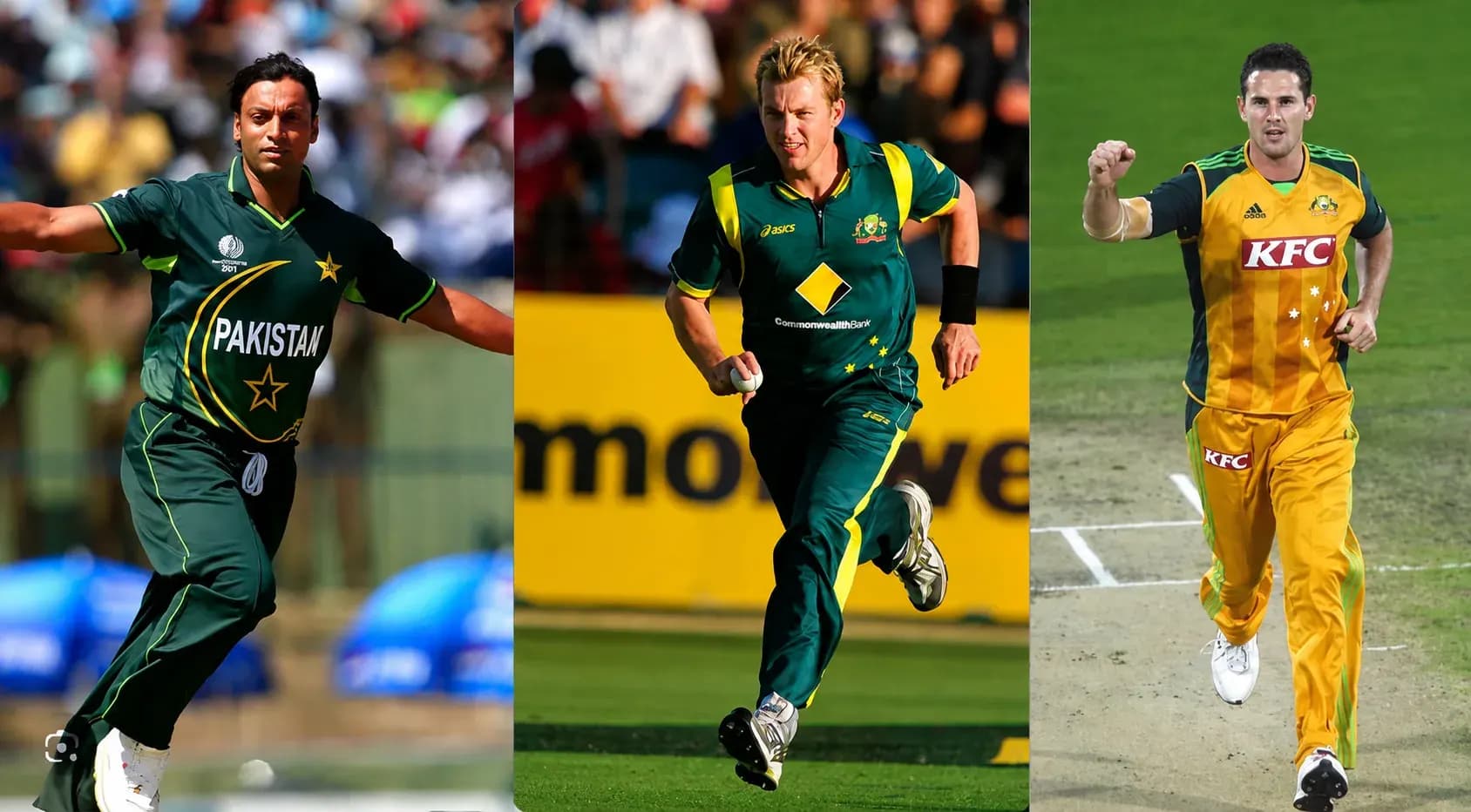
Representative image for illustration
Cricket has always had a different kind of excitement when there is fast bowling. At over 150km/h, a batter only has a fraction of a second to react when the ball is coming in at that speed, and only a small group of bowlers have consistently bowled at those extreme speeds. The Top 10 Fastest Bowlers in International Cricket have been some of the most feared pacers the game has seen. Pakistan s Shoaib Akhtar still holds the top spot with his famous 161.3 km/h (100.23 mph) delivery against England in the 2003 Cricket World Cup. Other great quicks have come very close, with Australia’s Brett Lee and Shaun Tait also breaking the 160km/h barrier. Just because someone is fast doesn’t make him a great bowler. Accuracy, movement, fitness, control and being able to take wickets in different conditions are equally important. However, the ability to bowl 150 km/h or more is still one of the most impressive physical feats in the game.
Here is a look at the fastest bowlers, their fastest recorded speeds and the performances that earned their reputations.
Top 10 Fastest Bowlers in the History of International Cricket
| Rank | Bowler | Country | Fastest Speed Recorded |
|---|---|---|---|
| 1 | Shoaib Akhtar | Pakistan | 161.3 km/h (100.23 mph) |
| 2 | Brett Lee | Australia | 161.1 km/h (100.1 mph) |
| 3 | Shaun Tait | Australia | 161.1 km/h (100.1 mph) |
| 4 | Jeff Thomson | Australia | 160.6 km/h (99.8 mph) |
| 5 | Mitchell Starc | Australia | 160.4 km/h (99.7 mph) |
| 6 | Andy Roberts | West Indies | 159.5 km/h (99.1 mph) |
| 7 | Fidel Edwards | West Indies | 157.7 km/h (98.0 mph) |
| 8 | Mitchell Johnson | Australia | 156.8 km/h (97.4 mph) |
| 9 | Mohammad Sami | Pakistan | 156.4 km/h (97.2 mph) |
| 10 | Shane Bond | New Zealand | 156.4 km/h (97.2 mph) |
Historic speed lists can be all over the board, especially for bowlers of the past when the technology used to measure speed was different than the radar guns used today.
1. Shoaib Akhtar : 161.3 KPH
Shoaib Akhtar holds the most celebrated speed record for fast bowling in international cricket.
The Pakistan pacer, better known as the Rawalpindi Express, delivered a ball that registered 161.3 km/h (100.23 mph) against England in the 2003 ODI World Cup in Cape Town.
That delivery made Akhtar the first bowler officially recorded to have broken the 100mph barrier in international cricket.
Speed was only part of his menace. His long run up, explosive action, reverse swing and aggressive approach made him a particularly uncomfortable opponent.
Injury played a part at different stages of his career but few bowlers inspired the same sense of danger when operating at full pace.
His 161.3 km/h mark still remains the benchmark more than two decades later and keeps Akhtar at the top of the Top 10 Fastest Bowlers in International Cricket.
2. Brett Lee – 161.1 Kmph
Brett Lee produced terrifying speed with a supremely fluent bowling action. In his prime years, the Australian pacer was often clocked over 150 km/h and his fastest was around 161.1 km/h. Lee was part of a fearsome Australian attack, and could trouble batsmen with pace, yorkers and movement. But longevity was what separated him from many pure speedsters. The physical toll fast bowling takes on the body makes it difficult to maintain an extreme pace for a long international career. Lee was a big part of Australia’s attack in both Tests and limited overs cricket despite serving up spells at serious pace.
3. Shaun Tait – 161.1kph
Shaun Tait was one of cricket’s most naturally explosive fast bowlers. His unorthodox slingy action generated huge pace, with speeds of around 161.1 km/h being clocked against England. Tait’s international career was shorter than many bowlers on this list, partly because bowling at such intensity put enormous strain on his body. But he was a very tough guy to play against at his best. In limited-overs cricket, he was particularly dangerous with a combination of erratic movement and sheer pace.
4. Jeff Thomson - 160.6 kph
Jeff Thomson terrorised the opposition with his pace in the 1970s and remains one of the quickest bowlers the game has ever produced. His slinging action produced insane speed, with historical testing putting him around 160.6 km/h. And Thomson’s pace is even more impressive when you consider the equipment and conditions under which he was playing. Batters faced him without many of the protective innovations today’s players enjoy. Thomson and Dennis Lillee were part of one of the most feared fast bowling partnerships in Australia. It’s difficult to compare historical speed measurements with today’s radar technology, but Thomson’s reputation among the players who faced him leaves little doubt about his exceptional pace.
5. Mitchell Starc – 160.4 km/hr
Mitchell Starc has been one of the quickest left-armers of the modern era. The Australian quick bowled a 160.4 km/h delivery against New Zealand in the 2015 Test at the WACA in Perth. Starc’s biggest strength is not just pure pace. His late swing, left-arm angle and capacity to bowl deadly yorkers make him a threat with both the new ball and the old ball. He has also had some big performances in World Cups and Test cricket proving that extreme pace can be mixed with sustained international success and cementing his place among the Top 10 Fastest Bowlers in International Cricket.
6. Andy Roberts – 159.5 KPH
Sir Andy Roberts was one of the creators of the great West Indies fast bowling tradition. Roberts was a fast and clever bowler in an era when the Caribbean was producing some of the most fearsome pace attacks the game has ever seen. His fastest deliveries have been clocked at around 159.5km/h in the past. But he wasn’t just trying to throw every pitch as hard as he could. Roberts varied his pace well and mixed his bouncers to keep the batters guessing. Beyond the numbers, his influence helped create the fast-bowling culture that would come to define West Indies cricket for years to come.
7. Fidel Edwards – 157.7km/h
In the 2000s the West Indies had a genuine pace bowler in Fidel Edwards. His action was compact and sling-like and he was able to bowl up to 157.7 km/h. Edwards was particularly good when pitches gave him a chance to hit the ball off the fence. His release made the ball hard to pick up, and his speed took time away from the batter’s reaction time. Injuries meant he could not keep that up for his entire international career, but at his quickest he was comfortably one of the fastest bowlers of his generation.
8. Mitchell Johnson - 156.8 km/h
Mitchell Johnson’s fastest deliveries were around 156.8 km/h, but numbers don’t tell the whole story of how intimidating he became. His performance in the 2013-14 Ashes series remains one of the most memorable fast-bowling performances of the modern age. Johnson combined pace with an awkward bounce and a left-arm angle that kept England s batsmen guessing. When he was in his rhythm he could turn a Test match in a short spell. His career was an important point about fast bowling: sustained hostility can count for more than one ball of exceptional speed.
9. Mohammad Sami – 156.4 km/h
Pakistan has a long history of fast bowlers and Mohammad Sami was one of the fastest. Sami could run around 156.4 km/h and had some serious pace early in his international career. His natural pace was never in question, even though his overall record did not compare with some of Pakistan s other fast-bowling greats. With Shoaib Akhtar he gave Pakistan an attack that could test batsmen with genuine pace from both ends.
10. Shane Bond – 156.4kph
Shane Bond was one of New Zealand’s most lethal fast bowlers. At his peak Bond was about 97 mph and that speed was combined with great control and movement. His greatest challenge was injury. His persistent fitness problems meant he was rarely available for international duty and cricket fans didn’t get to see as much of him as they might have liked. But when fit Bond could trouble even the world’s strongest batting lineups. He was much more than a bowler who just clocked high numbers on a speed gun because of his wicket taking ability, his pace and his accuracy.
Who bowled the fastest ball in Cricket history
Shoaib Akhtar is widely acknowledged as the fastest delivery in international cricket, having bowled at 161.3 km/h (100.23 mph) against England at the 2003 Cricket World Cup. The record has stood the test of time through several generations of fast bowlers and is still the standout figure when talking about the Top 10 Fastest Bowlers in International Cricket. Brett Lee and Shaun Tait both came very close to that mark at 161.1 km/h while Mitchell Starc later reached 160.4 km/h. Beating Akhtar s record requires an extraordinary combination of physical power, technique, timing and conditions.
Why is it so difficult to bowl over 150km/h?
The human body is subjected to great strain by fast bowling. During the delivery stride a fast bowler generates force through the legs, hips, core, shoulders and bowling arm in a very short period of time. The front foot lands and the body has to repeatedly absorb a lot of impact. That goes some way to explaining why so many extreme pace bowlers have had injury problems during their careers. So modern fast bowlers depend a lot on strength training, managing their workloads, recovery programmes and sports science.
“Bowl at 150 km/h only once is not easy. Doing it over and over again is much harder to be accurate.
Is Speed Enough to be a Good Fast Bowler?
No, Pressure is created by speed, but the best fast bowlers have pace and other skills.
Accuracy makes batters play. Uncertainty is created by swing. Challenges seam movement skills. A bouncer of some pace can push a batsman onto the back foot and a yorker at the other end of the length spectrum can be a wicket-taking option. Hence some bowlers who did not even get close to 150 km/h often became all-time greats. Raw pace garners attention. Careers are based on control and flexibility.
Fastest Bowlers: Pakistan, Australia and West Indies Lead the Pack
What’s more intriguing about the Top 10 Fastest Bowlers in International Cricket is the fact that there are several bowlers from Australia, Pakistan and the West Indies. Australia has produced Brett Lee, Shaun Tait, Jeff Thomson, Mitchell Starc and Mitchell Johnson from various eras. Shoaib Akhtar and Mohammad Sami were two of the great fast bowlers from Pakistan who made a name for themselves with their pace and reverse swing. The West Indies had built an era around fast bowling and Andy Roberts helped establish a tradition that was carried on by generation after generation of Caribbean pacers. All three cricket cultures had strong identities built around genuine pace, produced by different techniques, pitches and coaching systems.
CricLegacy Expert Review
It is easy to see why there is an obsession with fast bowling records. As soon as a speed gun flashes up 150 or 160 km/h you get noticed straight away. But the most interesting thing about this list is the diversity of the bowlers. Shoaib Akhtar bowled fast. Jeff Thomson had a funny slinging action. Brett Lee appeared pretty smooth. Mitchell Starc uses height, left arm angle and swing. There is no one formula to extreme pace. There is also a difference between the fastest delivery and the best fast-bowling career. A bowler can reach close to 155 km/hr but does not regularly trouble the best batsmen. Someone else might be a few kilometres slower, but will use guile, accuracy and awareness to claim many more wickets. That difference is important when you rank the Top 10 Fastest Bowlers in International Cricket because the recorded speed tells only one part of the story for each bowler. Speed records show us who bowled the fastest balls in cricket history. They don’t just tell us who was best.
Frequently Asked Questions
Q1. Fastest bowler in international cricket.
The title of fastest bowler in international cricket goes to Shoaib Akhtar of Pakistan. In a One Day International against England at Southampton in 2003, he was timed at 161.3 km/h (100.2 mph) by the speed gun. Shoaib Akhtar is universally acknowledged to hold the world record when he bowled at 161.3 km/h against England at the 2003 World Cup.
Q2. What was Shoaib Akhtar s fastest ball?
His record delivery was 161.3 km/h or 100.23 mph .
Q3. Which bowlers have bowled at over 160 km/h?
Historical speed testing has shown that Shoaib Akhtar, Brett Lee, Shaun Tait, Jeff Thomson and Mitchell Starc have all been associated with speeds above 160 km/h.
Q4. Who is the fastest bowler in Australia?
Jeff Thomson was clocked at around 160.6 km/h in the old measurements and is one of the fastest Australians. Brett Lee and Shaun Tait have both clocked over 161 km/h in the modern measurements.
Q5. Brett Lee – How fast was he?
Brett Lee is quoted as the fastest recorded speed by him as around 161.1 km/h.
Q6. The fastest ball bowled by Mitchell Starc?
Starc bowled a 160.4 km/h delivery against New Zealand in Perth in 2015.
Comments (0)
No comments yet. Be the first to share your thoughts!