Test vs ODI vs T20 Cricket: What's the Real Difference?
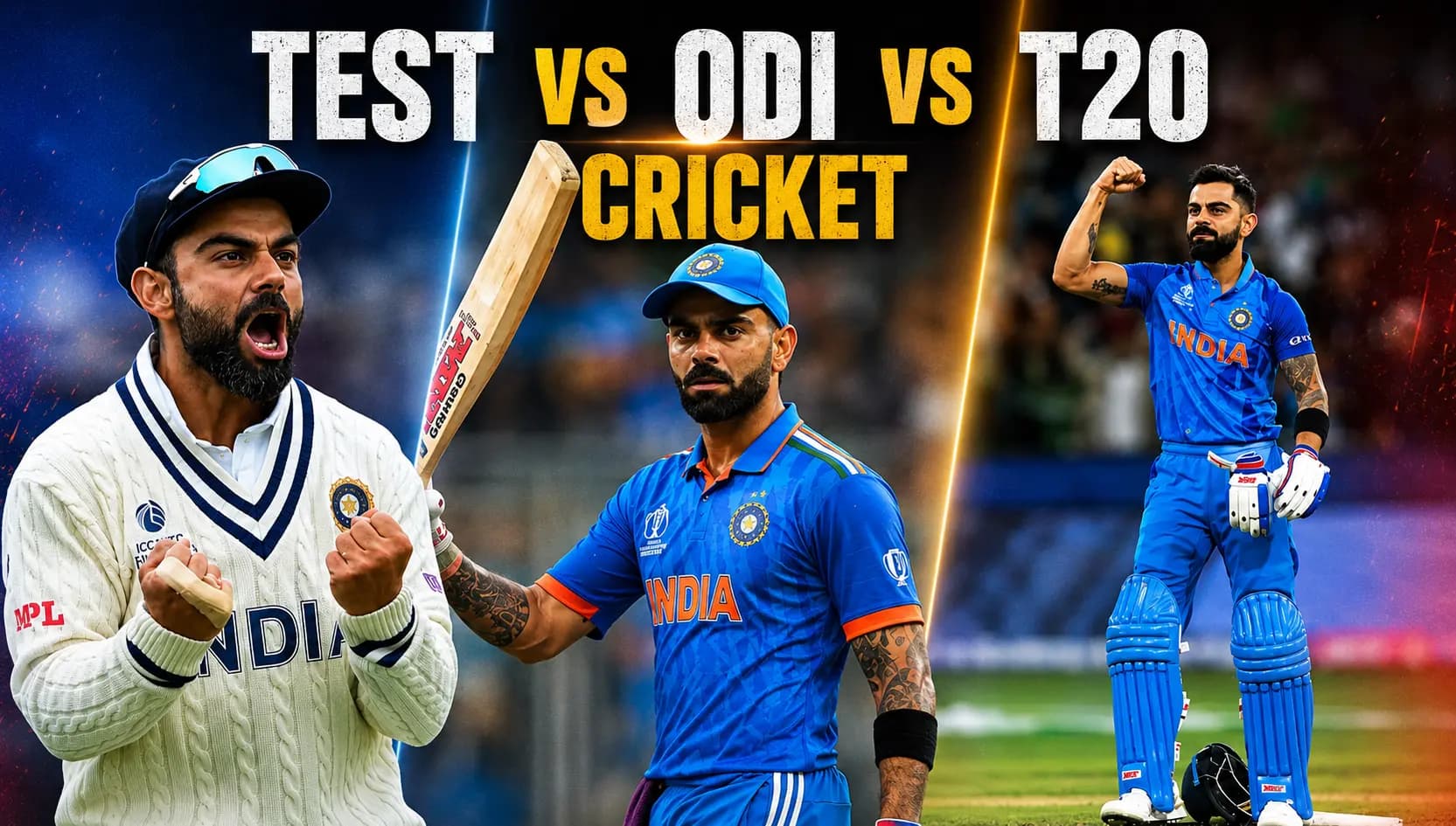
Representative image for illustration
Test cricket is played over 5 days , with unlimited overs per innings , and can end in a draw. The One Day International (ODI) format is a one day match with each side getting 50 overs. The shortest format of cricket, T20 cricket has only 20 overs per side and normally finishes in about 3 hours. The main difference is time, overs and strategy. Test is about patience and technique, ODI is about aggression with game management and T20 is about quick runs and entertainment.
What Is Test Cricket?
Test cricket is the oldest and longest format of the game, with England and Australia playing the first Test in 1877. A Test match is played over 5 days, with each team having to bat and bowl twice. There is no limit on innings, it can consist of any number of overs. In theory a team can bat for the whole of the two days if the pitch and bowlers allow it.
Test Cricket: Main Attributes
Duration: 5 days (6 hours of gameplay each day)
Innings: 2 for each team
Ball: Red (pink for day-night Tests)
Kit: White (traditional)
Possible outcomes: Win, loss or draw (a peculiarity of Test cricket)
Best Competition: ICC World Test Championship (WTC)
The biggest difference between Test cricket and the other two formats is the follow-on rule . If a team is bowled out and is behind by a big margin ( 200+ runs in a 5 day Test ) , the other team can force them to bat again right away . This rule is not in ODI or T20 cricket as these formats have just one innings each to begin with.
What is One Day International Cricket?
ODI is short for One Day International. Its origins date back to 1971 when it was devised as a faster alternative to Test cricket, partly because a rain-affected Test match in Melbourne needed a quicker format to fill the final day. Each team bats for a maximum of 50 overs in a single innings and the match is finished in one day (roughly 7-8 hours).
ODI Cricket Main Features
Duration: ~8 hours, 1 day
Innings: 1 apiece
Overs: 50 each side (max 300 balls)
Ball: White
Kit: Team kits in color
Result types Win, loss, tie, no result
Best competition ICC Cricket World Cup
Furthermore, ODI cricket has fielding restrictions (powerplays) that do not exist in Test cricket — only a limited number of fielders are allowed outside the inner circle in the first 10 overs, forcing bowlers to attack and giving batters more room to score early on.
What Is T20 Cricket?
T20 (Twenty20): The newest and shortest format of the game, introduced in 2003 by the England and Wales Cricket Board (ECB) to bring in bigger crowds and TV audiences. Each team gets 20 overs each innings and a full match is over in about 3 hours - like watching a football match.
Features of T20 Cricket
Time : 3 hours ~
Innings: 1 apiece
Overs: 20 a side (Max 120 overs)
Ball – The white ball
Kit Team kits in color
Types of results: win, lose or tie (often settled with a Super Over)
Major tournaments: ICC T20 World Cup, IPL, Big Bash League & other domestic T20 leagues
T20 cricket is where you will see the most aggressive batting. The overs are so limited that every ball matters and the batters take far more risks than they would in a Test match where they have days to build an innings.
Test Vs ODI Vs T20: Complete Comparison Table
| Feature | Test Cricket | ODI | T20 |
|---|---|---|---|
| Duration | Up to 5 days | 1 day (~8 hrs) | ~3 hours |
| Overs per side | Unlimited | 50 overs | 20 overs |
| Innings per team | 2 | 1 | 1 |
| Ball color | Red (or pink) | White | White |
| Playing kit | White clothing | Colored kits | Colored kits |
| Introduced in | 1877 | 1971 | 2003 |
| Follow-on rule | Yes | No | No |
| Result type | Win, loss, or draw | Win, loss, tie, or no-result | Win, loss, or tie (Super Over) |
| Top tournament | ICC World Test Championship | ICC Cricket World Cup | ICC T20 World Cup / IPL |
So how does strategy really differ between formats?
Most of the explainers miss this part, the rules matter but the thinking behind the rules is what really separates the formats.
Test cricket bowlers plan wickets over hours, not overs. A bowler can torment a batsman for an entire session and then bowl him out. Bowlers rotate to manage fatigue over 5 days Batters often value survival over scoring in tough conditions
In ODI cricket, teams build innings in phases – a cautious start, an aggressive middle overs push and a full throttle last 10 overs (the “death overs”). Bowlers keep their best deliveries for the death overs and not the start.
There’s not much time to build anything in T20 cricket. The batsmen attack from ball one often and the bowlers depend a lot more on variations (yorkers, slower balls, wide yorkers) as compared to the other formats as containing runs matters as much as taking wickets.
What Format Should A New Fan Start With?
If you are new to cricket, T20 is the easiest way in - it is short, it is fast and it is closest in pace to other mainstream sports like football or basketball. Once you get the basics ( overs , wickets , boundaries ) , ODI cricket is a natural progression . It has more tactical depth , without the 5 day commitment . Test cricket is best enjoyed when you already have a grasp of the sport — it rewards patience and a greater awareness of technique, conditions and game-state pressure, which is difficult to appreciate without context.
Why are there three formats anyway? A Brief History
Cricket didn’t begin with three formats – it evolved into them, and knowing why makes it so much easier to remember the differences.
Test cricket began in 1877, when England and Australia competed in what is now known as the first official Test match in Melbourne. For almost a century this was the only form of international cricket. It was meant to be a real test of skill, patience and endurance — hence the name “Test.”
The birth of ODI cricket was almost accidental. January 1971: England and Australia’s Test match at the Melbourne Cricket Ground is rained off for three days. Officials organized a one-day, 40-overs-a-side game on the last day to give fans something to watch. It was a success and the first ever Cricket World Cup was held using the 60 over format (later standardized to 50 overs) in England in 1975 .
The youngest of these three formats is T20 cricket, introduced in 2003 by the England and Wales Cricket Board to reverse the decline in domestic match attendance. The format was an instant hit and led directly to the creation of the Indian Premier League (IPL) in 2008 — today the most-watched domestic cricket league in the world and a league that has reshaped how the entire sport is played, coached and consumed.
The timeline is important because it reveals the character of each format: Test cricket was not made for entertainment, it was made to genuinely test a player s skill over days. ODI was a practical solution which became a global tournament. T20 was always meant to be about entertainment for the masses, in the shortest time possible.
How does fielding differ across the three formats?
One of the most misunderstood differences between formats is fielding restrictions, which directly influence how batters approach their innings.
Test Cricket Fielders
There are no restrictions on the number of fielders in Test cricket. Captains can at any time during an innings place as many fielders as they wish anywhere on the field. That means you are able to position the field very defensively or very aggressively, depending on the match situation, which is something you will never see in white-ball cricket.
The Fielding Game in One-Day International Cricket
### ODI cricket has a powerplay system
Overs 1 to 10: Only two fielders allowed outside the 30-yard circle
Overs 11-40: Max 4 fielders outside the circle
Overs 41-50: Maximum of 5 fielders outside the circle
The structure is built to promote attacking batting upfront, tactical rebuilding in the middle overs and all-out aggression at the death.
T20 Cricket Fielding
T20 cricket has a shorter sharper power play.
Overs 1-6: 2 fielders outside the circle
Overs 7 to 20: Only five fielders allowed outside the circle
T20 batting is much more front-loaded with aggression than in ODI cricket . Teams generally try to score as quickly as they can in the first six overs while fielding restrictions are in place . The powerplay window is so short compared to total innings that
How Is Scoring and Run-Rate Different Across Formats?
One of the easiest ways to tell the difference between formats is just by looking at a scoreboard.
Test match run rates tend to be between 2.5 and 3.5 runs per over but this is very dependent on pitch conditions and the match situation. But a team batting to save a draw might intentionally score at less than 2 runs an over.
In ODI cricket , the run rates in the 5-6 runs per over range are common across the entire innings . The middle overs are often slower ( 4-5 RPO ) and the death overs quite a bit faster ( 8-10+ RPO ) .
T20 cricket run rates are between 8 to 9 runs per over and many teams now regularly cross 10 RPO in competitive T20 leagues like the IPL.
This is also the reason strike rate (runs scored per 100 balls) is the primary batting metric in T20 cricket, while batting average (runs scored per dismissal) is still the primary metric in Test cricket — the formats literally reward different skills.
Aside From the Basics, What Equipment and Rules Are Different?
There are a few other differences which are often missed out but are important for a real understanding of the sport :
New ball: Test cricket gets a new ball after every 80 overs. In an ODI, there are two new balls, from each end, used throughout the innings. Normally only one new ball is used per innings in T20 cricket because it is a shorter format.
Over-rate penalties All three formats have over-rate rules to keep the game moving but T20 leagues (the IPL included) have strict time-out penalties where fielding teams have to bring in an extra fielder inside the circle if they are too slow, a direct punishment for time-wasting that Test cricket doesn’t have.
Umpire s Decision Review System (DRS) The system is available in all three formats of the game at the international level but the number of reviews is different for each team in an innings. Test cricket, owing to the longer duration of the match, has more reviews per innings than the white-ball formats.
Substitutions: T20 leagues like the IPL have brought in an Impact Player rule, where a like-for-like substitution can be made during the match — a tactical option that simply doesn’t exist in Test or ODI cricket at all.
Which Format Breeds the Best Cricketers?
It is a genuine debate among fans and former players and one that is worth tackling head on rather than avoiding. Test cricket is generally seen as the ultimate test of a complete cricketer. Batters need technique to survive swinging and seaming deliveries over days, and bowlers need stamina and skill to take 20 wickets in a match. For legends like Sachin Tendulkar, Sir Don Bradman and Muttiah Muralitharan, test performances were the main currency.
In ODI cricket, you have to have a more balanced skill set -- batters need technique as well as the ability to accelerate, and bowlers need control in different phases of the innings. Players like Virat Kohli and AB de Villiers are always spoken about as some of the best ODI batters of all time due to their ability to chase big totals under pressure.
T20 cricket is a game that rewards a very specific skill set - power-hitting, sharp reflexes and the ability to perform under intense, condensed pressure. Players like Chris Gayle, Andre Russell and Jos Buttler built their name on the world stage largely through T20 leagues, and not Test or ODI cricket. Honestly, no format produces a better cricketer, it just rewards a different set of skills. That is why you see very few cricketers these days who are considered truly world-class in all three formats.
FAQs : Cricket Test, ODI & T20
Q1. What is the longest format of cricket?
Test cricket is the longest format of the game, played over a maximum of 5 days with an unlimited number of overs to be bowled per innings. That s why a Test match can go for over 800 overs of cricket, with each side batting and bowling two innings. It s also the only format where weather delays or bad light can really eat into playing time, without a fixed overs safety net.
Q2. How many overs are there in ODI cricket ?
An one-day international ( ODI ) game is 50 overs per side , so each team can face a maximum of 300 balls in their innings . The format has different phases – the powerplay overs, the middle overs and the death overs – which require a different approach to batting and bowling. A full ODI (one innings per side) match will take ~7-8 hours including breaks .
Q3 . Which is the shortest format of cricket?
T20 cricket is the shortest format. Each side bats for 20 overs. The entire match usually takes about three hours. T20 is especially unpredictable because the innings is so short, teams have very little time to recover from early setbacks. This shortened format is also the reason for the massive popularity of T20 leagues such as IPL among broadcasters and casual fans.
Q4. Is a Test capable of ending in a draw?
Yes, unlike ODI and T20 cricket Test matches can be drawn if the match runs out of time before a result is reached even if one team is clearly ahead. This is because a team may bat defensively for long periods just to save wickets and run the clock down. Test cricket is defined by drawn games and purists regard this as part of the tactical richness of the form.
Q5. Why does test cricket use the red ball and ODI and T20 use the white ball?
Red balls have a longer lifespan and are more easily visible in daylight for 5 days . White balls are more visible under floodlights , hence they are used in day-night ODI and T20 matches . A red ball also tends to move more and stay shiny for longer, which suits the longer, more technical nature of Test cricket. Conversely, white balls wear out faster and become harder to see as they age, especially under lights in the later stages of an innings.
Q6. What What is the follow on rule in cricket?
The follow-on rule is only for Test cricket – if a team gets bowled out and is behind by a big margin (usually 200 runs in a 5-day Test), the other team can make them bat again immediately instead of batting themselves. The rule exists simply because Test cricket allows for more than one innings per team while ODI and T20 formats do not. Captains don’t always enforce the follow-on when they can, because it can leave bowlers exhausted without a break to bat in between.
Q7. Good books for data structures and algorithms?
Which cricket format is the most popular worldwide? Today T20 cricket, especially in leagues such as the IPL, commands the biggest global audiences and viewership, but Test cricket is still highly revered by traditional fans as the original “purest” format. The shorter format of T20 is more accessible to casual viewers and new markets like the USA than a 5 day commitment. And in between there is ODI cricket, still pulling in big crowds in major tournaments such as the Cricket World Cup.
Q8. What happens when a T20 match is tied?
A tied T20 match is generally resolved by a Super Over – a one-over eliminator in which both teams bat one over each to determine the winner. Most tournaments continue with additional Super Overs if the Super Over is also tied until there is a winner. The rule was introduced in such a way specifically because the short format of T20 cricket has made traditional tie-breakers such as boundary count controversial in high-stakes matches.
Q9. Yes IPL is a T20 cricket league.
Yes – the Indian Premier League (IPL) is one of the biggest T20 leagues in the world, with the same 20 overs per side format as international T20 cricket. The IPL, launched in 2008, brought together international stars and Indian domestic talent in a franchise system that lifted the format’s global profile to new heights. It is still the most lucrative cricket league on the planet and has directly inspired the rise of similar T20 leagues worldwide.
Q10. What is the most aggressive use of fielding restrictions?
The powerplay is the most condensed in T20 where only 2 fielders are allowed outside the circle for just the first 6 overs . Hence batters attack harder and earlier in T20 than in ODI or Test cricket . The powerplay is 30% of the entire innings, which is more than in ODI cricket and therefore teams see it as an important time to score. In T20 cricket losing wickets early in this phase is far more expensive than in the longer versions because there is little time to rebuild.
Q11. Why do batters have different stats in different formats?
Batting average is the key metric of test cricket (runs per dismissal) because survival is paramount; strike rate (runs per 100 balls) is the key metric of T20 cricket because scoring speed is paramount; and ODI cricket values a balance of both. If a Test batter has a high average but scores slowly, they are still considered elite, whereas the same approach in T20 cricket would be considered a liability. And that’s why some players are so good at one format but can’t translate their game to another.
Comments (0)
No comments yet. Be the first to share your thoughts!